

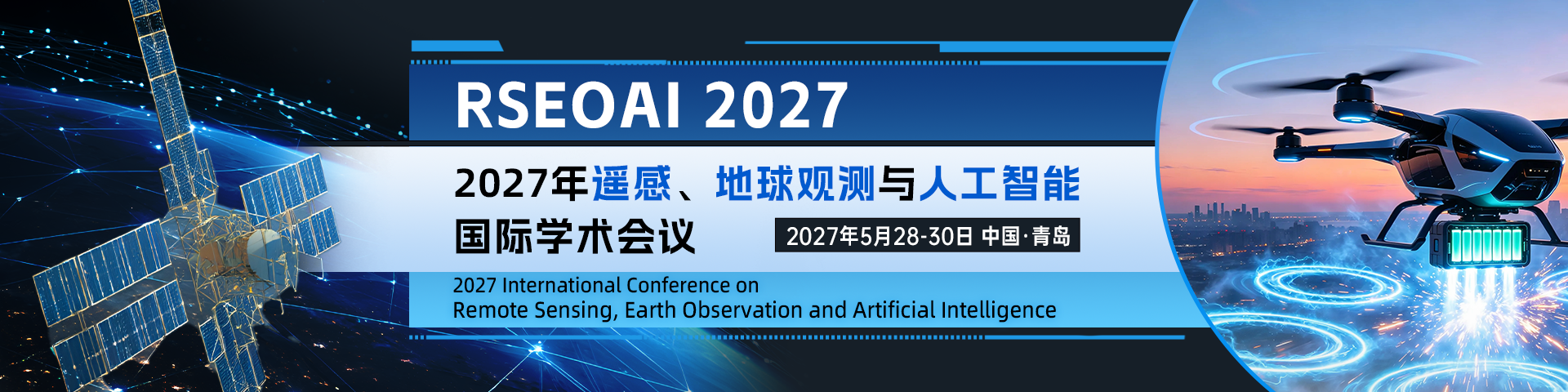

About RSEOAI 2027
The 2027 International Conference on Remote Sensing, Earth Observation and Artificial Intelligence (RSEOAI 2027) will be held from May 28 to 30, 2027, in Qingdao, China. Organized by China University of Petroleum (East China), the conference aims to provide a high-level platform for researchers, engineers, and technical developers engaged in remote sensing, Earth observation, artificial intelligence, and interdisciplinary fields to share scientific achievements and cutting-edge technologies. We cordially invite experts, scholars, and professionals from universities, research institutions, and industries worldwide to participate in this academic exchange.
The core theme of the conference centers on the deep synergy and innovative applications of remote sensing, Earth observation, and artificial intelligence (AI) technologies. It seeks to leverage these advanced tools to more effectively perceive, understand, model, and manage complex Earth systems and human–environment interactions. Special emphasis will be placed on the enabling role of AI technologies in energy remote sensing, marine remote sensing, environmental monitoring, and the advancement of sustainable development goals. The conference is committed to fostering multidisciplinary integration and innovation across remote sensing, Earth observation, and AI, contributing to energy security, environmental protection, marine development, carbon neutrality, and sustainable development.
Conference Info.
🗓︎Important Dates
Full Paper Submission Date: January 24, 2027
Notification of acceptance: February 23, 2027
Registration Deadline: March 10, 2027
Final Paper Submission Date: March 25, 2027
Conference Dates: May 28-30, 2027
🗺︎Venue: Qingdao, China
Call For Papers
📚︎ I. AI-Empowered Remote Sensing and Intelligent Earth Observation
Deep learning for remote sensing image classification, segmentation, and object detection; AI foundation models and vision transformers for geospatial analysis; Self-supervised and few-shot learning for remote sensing applications; Intelligent change detection and time-series analysis; Multi-modal data fusion and feature alignment; Explainable AI and uncertainty quantification in Earth observation; On-board AI processing and real-time satellite data analytics
📚︎ II. Remote Sensing for Energy, Resources, and Marine Environments
Hyperspectral and multispectral remote sensing for mineral and hydrocarbon exploration; SAR and InSAR for subsurface structure imaging and ground deformation monitoring; Marine remote sensing for ocean dynamics, sea surface temperature, and salinity; AI-assisted detection of marine oil spills, red tides, and algal blooms; Remote sensing for offshore wind energy resource assessment; Seafloor mapping and deep-sea exploration using acoustic and optical remote sensing; Satellite altimetry for ocean circulation and sea-level rise monitoring
📚︎ III. Environmental Monitoring, Carbon Cycle, and Geohazards
Remote sensing of atmospheric composition and air quality; Vegetation monitoring, biomass estimation, and carbon stock assessment; AI-driven ecosystem modelling and biodiversity conservation; Wetland mapping and water resource management using remote sensing; Glacier retreat, permafrost degradation, and climate change impacts; Landslide, subsidence, and earthquake monitoring via InSAR and optical imagery; AI-based early warning systems for geological disasters; Post-disaster damage assessment and rapid response using remote sensing
Publication
All papers will be reviewed by two or three experts from the committees. After a careful reviewing process, all accepted full papers will be published by Conference Proceeedings and will be submitted to EI Compendex, Scopus for indexing.


Note: All submitted articles should report original research results, experimental or theoretical, not previously published or under consideration for publication elsewhere. Articles submitted to the conference should meet these criteria. We firmly believe that ethical conduct is the most essential virtue of academics. Hence, any act of plagiarism or other misconduct is totally unacceptable and cannot be tolerated.
Sponsor
 |